
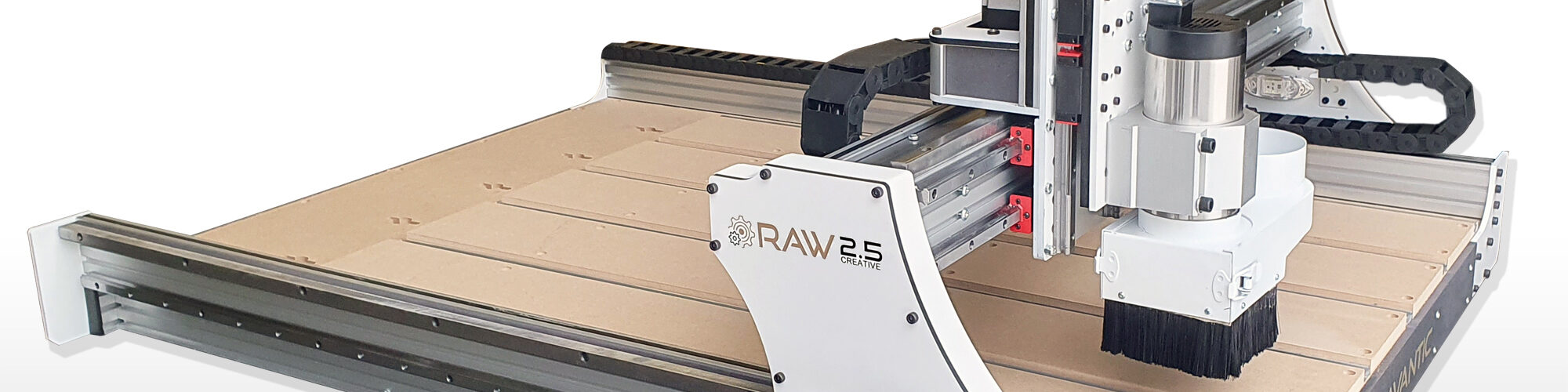
This forum is still new and may look a bit empty at the moment.
Please don’t hesitate to ask your questions. If you are building a Raw Creative 2.5, planning your build or wondering about parts, setup or assembly, feel free to start a topic.
I will do my best to answer questions and help as much as I can. As more builders join, the forum will grow into a useful place for tips, build discussions and shared experience.

I know many people are interested in this version, especially for larger machines and longer travel distances, so I want to be transparent about the current status.
The plan is to publish the illustrations and drawings first, so members can start understanding the layout, components and mechanical setup. The full build video will come later.
This takes time because these are not simple machines. Even though the concept may look straightforward from the outside, there are many details that need to be correct: alignment, motor placement, gear reduction, rack positioning, tensioning, calibration and general assembly order.
Many of the parts used in the belt version will also be reused for the rack version. The frame, linear rails, motors, electronics and many general components are the same or very similar.
The parts that change are mainly related to the drive system. The rack version uses rack and pinion components instead of belts and idlers, and some of the steel plates are different between the versions.
To make this easier, we also have steel plates available on our website. Some of these plates are designed to be more universal between the different versions, which makes it easier to build or upgrade without starting completely from zero.
So in short: the rack version is coming, but it is not fully documented yet. I will release the illustrations first, and then the video will follow when it is ready.

I look forward to following along. I currently have a Shapoko 5 pro 2'x4' version and am looking to get a larger machine, and plan on going with the rack version.
I have going through the frame and cable calculator and had a question. I want to max my X -axis, and keep with nice round lengths for rack parts. so putting the max 1500 in tells me I need X-rack of 1490 mm. rack lengths come in increments of 100 mm, do you cut those? or can I just round everything up 10 mm? or can you modify the calculator to allow me to put 1510 in?
thanks,
Dan
Hi Dan,
Great to hear that you are planning to build the rack version.
Yes, it is normally very easy to cut the rack to the correct length. The rack can be cut with a metal saw, angle grinder, bandsaw or similar, and then the end can be cleaned up with a file or grinder. It does not need to be complicated.
In your example, if the calculator says 1490 mm rack, I would simply use a 1500 mm rack and cut it down if needed.
You can also use a slightly shorter rack, for example 1400 mm, because the X-axis will never use the full outer length of the frame anyway. The gantry and carriage have their own offset, so the machine does not physically reach all the way out to the very end of the X frame.
So you do not need to change the calculator to 1510 mm. I would keep the calculator values as the real design reference, and then adapt the rack length practically when you build.
So in short:
Use 1500 mm rack and cut it if needed, or use 1400 mm if you want to keep it simple and the available travel still fits your needs.

I'm looking forward to this build as well. I'm looking to be able to process 1220 x 2480 sheet materials. Here in the US, 4 ft by 8 ft sheet panels are the common size.
I'm very impressed with RawCNC's attention to all the detail of craftsmanship as well as all the various ideas and methods to achieve the end result. Grattis och lycka till.

Same boat as Davin Tormanen. Unless it complicates the design or come with other drawbacks I'll be aiming for a rack version in "full sheet size".
Thank you for running this project!
Tack! Yes the rack version is a tested machine and it has very good cutting results and perfect for larger machines.
Same boat as Davin Tormanen. Unless it complicates the design or come with other drawbacks I'll be aiming for a rack version in "full sheet size".
Thank you for running this project!
If you think the belt version looks manageable, than the rack version is as easy, i can take the belt version as it is now and convert it to racks in an hour, it is that easy.

I'm planning on building the 2.5 very soon. I am looking to use it to make steel parts. Would you recommend rack over other options for this use?
For steel cutting, I want to be a little careful with my recommendation.
The Raw Creative 2.5 is an aluminium profile based machine, and I would not personally choose an aluminium frame machine as my first option if the main goal is to cut steel parts. Steel cutting requires a lot of stiffness, mass, correct feeds and speeds, good tooling, and usually a more industrial type of machine if you want to do it reliably.
That said, if you want the strongest drive options for the Raw Creative platform, I would look at either rack and pinion or ball screws.
Ball screws are a very good option for smaller, more precision-focused machines. They are stiff, smooth and give good repeatability when installed correctly.
Rack and pinion is the better option if you want a larger machine or longer travel distances. It is strong and practical for bigger builds, but it still does not change the fact that the machine frame itself is aluminium.
So my honest answer is:
If your main goal is steel cutting, I would probably not build an aluminium CNC router for that purpose.
If you mainly want to cut wood, plastics and aluminium, with maybe very light steel engraving or very careful light passes sometimes, then the machine can still be useful.
For the strongest Raw Creative versions:
-
smaller precision machine: ball screw
-
larger machine: rack and pinion
But for regular steel part production, I would recommend a much heavier steel-frame machine.
RawCNC,
Thanks for your honest reply. It is truly appreciated. I might abandon my plans for steel cutting and plan on only aluminium for the machine which is still the majority of my needs anyway. If I was planning on a 650x650 cutting surface, what maximum thickness of aluminium material do you think I'd be capable of cutting with good precision? I'm looking at using ball screws
Hi Dave,
Yes, aluminium is a much better match for this type of machine than steel.
With the correct settings, you can cut a lot of aluminium on a machine like this. We have cut hundreds of meters of aluminium on our own machines over the years without any major problems. The important thing is to use the correct cutter, correct feed rate, correct depth of cut, and not try to force the machine like a heavy industrial mill. We have a guide for this on the site.
Regarding thickness, there is not really a fixed maximum aluminium thickness in the same way people often think. If you take it slow and use multiple passes, the practical limit is usually more about the clearance under the gantry/Z-axis than the material thickness itself.
So if the aluminium plate fits under the machine and you have enough Z travel and tool length, you can cut thicker material by taking several shallow passes.
For a 650 x 650 mm cutting area with ball screws, I think aluminium work makes a lot of sense. A smaller machine with ball screws should be quite stiff and precise compared to a larger lightweight machine. A rack version of this machine will do the jobb as good as with ballscrew, but it's your choice.
Material choice also matters a lot. Some aluminium grades are much nicer to machine than others. I would look for machining-friendly grades such as 6082-T6, 6061-T6 or 7075-T6 if available. These usually cut much better than very soft aluminium, which can be gummy and stick to the cutter.
So in short: I would not worry too much about the thickness itself. Focus more on using a good aluminium grade, sharp tools, proper chip clearing, and conservative cutting settings.

I'm halfway through the build and need rack to continue. It isn't available on your web site. Do you have any update on when it will be available, or an alternate supplier (hopefully US)?
Has anyone actually purchased rack for this build. I cannot find mod 1 rack in the size specified in the BOM (15 x 17mm). Most is only 10 X 10MM. Would Mod 1.5 be an acceptable substitute?
Thanks in advance
Dave