
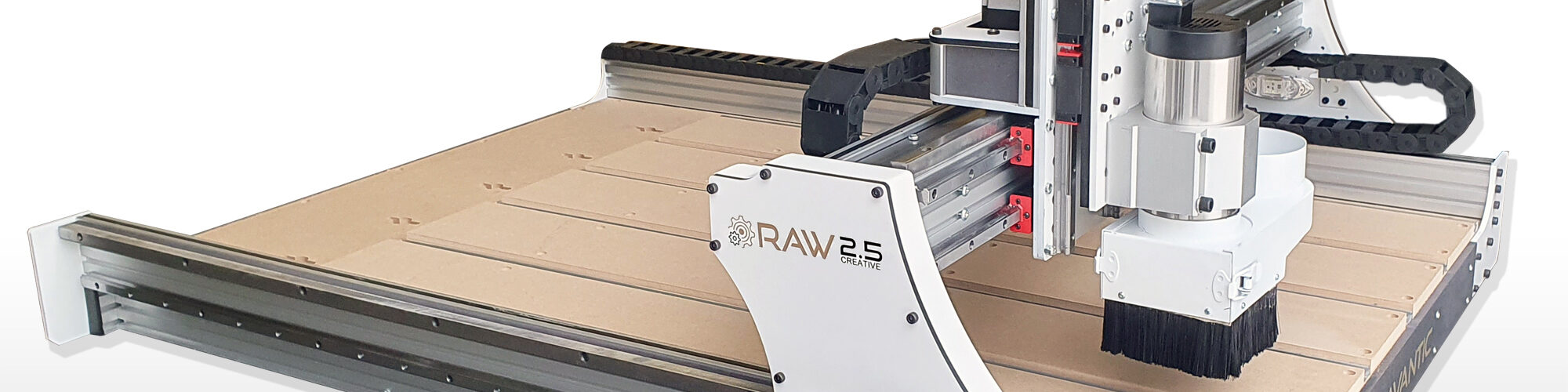
This forum is still new and may look a bit empty at the moment.
Please don’t hesitate to ask your questions. If you are building a Raw Creative 2.5, planning your build or wondering about parts, setup or assembly, feel free to start a topic.
I will do my best to answer questions and help as much as I can. As more builders join, the forum will grow into a useful place for tips, build discussions and shared experience.

I have a CNC previously that has a water-cooled spindle. Which is a hassle, since the machine has not been used all the time. My impression is that water-cooled spindles might need to run frequently to avoid corrosion within the internal parts. The spindle still works, but the clear tubes that transport coolant has become somewhat reddish around the connections to the spindle, indicating rust simply put.
So, to me air cooled seems to be a safer choice. I have a Makita router of the same type that is used in the build video. But I was thinking about putting a more substantial router on it. I have been looking at VFD-controlled aircooled routers. And I notice that for example Vevor (the chinese trader that has warehouses around the globe, including in the EU) offers several options. From 2.2-4 kW for example. Often they are mounted in a rectangular aluminium holder with brackets for mounting to the machine plate.
I know you spoke in a video about routers, but there's a lot of videos by now. So I wanted to open a discussion here. How should I think about things like:
* Power - what kW effects are appropriate for different usage application (mdf, hardwood, aluminium - and would it even be possible to cut harder metals with the right spindle and using very low feed rates?)
* VFD - using a VFD reduces noise and increases lifespan of router as far as I've previously learned. But it also introduces risk of electronic interference (EMD) as well with the machine itself as with the grid. What should one think about? And is there room in the kit box to fit a VFD for those who want to go down that route?
* Weight - how much motor weight can the machine handle (kit steppers in mind) before it becomes necessary considering adding a brake mechanism so the spindle does not drop when at rest?
* Does the choice of a "bigger" spindle as to its electrical power consumption change the needs regarding cable dimensioning? And does that affect the choice of cable chains?
As I am originally an electronics engineer, I want to add a small thought on the electric discussion for our american friends. In Europe we use a 230V grid at 50Hz. Since the electrical power law constitutes that power P=U*I where P is power, U is voltage and I is current, there is one important thing to remember.
Since the american grid voltage is about half of the European, to deliver the same amount of electrical power to the router you will need to have twice the amperage. That means that the cables used must have more copper. In machines I've been part of building, where we used 1,5mm2 wires, for the US versions we used 2,5mm2.

Good question. I will try to answer generally, but I also want to be honest and say that I do not have expert-level knowledge in every spindle/VFD/electrical setup.
Personally, I prefer air-cooled spindles for this type of machine. They are simple, reliable and you do not need pumps, coolant, hoses or maintenance of a water system. As long as you are cutting at reasonably high RPM, the cooling usually works well.
For the Raw Creative, I think a 1.5 kW air-cooled spindle is probably the best match. It gives a good balance between power, weight and simplicity.
A 2.2 kW spindle should also work, and the machine can handle the extra weight mechanically. But with this type of Z-axis, a heavier spindle can make the Z-axis drop when the motors are not powered. So that is something to keep in mind. If you go heavier, you may need to think about counterbalance, brake, stronger Z motor or simply always making sure the Z is parked safely when the machine is off.
For MDF, wood, plastics and aluminium, a 1.5 kW or 2.2 kW spindle is more than enough in most cases. I would not choose this machine if the main goal is cutting steel or harder metals. Very light engraving or very careful testing may be possible, but it is not what I would recommend the machine for.
A VFD spindle is nice because it is quieter than many trim routers, has better speed control and is more suitable for longer running times. The downside is that the VFD can create electrical noise, so cable routing, grounding and preferably shielded spindle cable become more important.
I would normally keep the VFD separate from the low-voltage control electronics if possible. The control box in the basic build is not really designed around a large VFD inside the same enclosure.
Regarding cable sizing, yes, the spindle power and voltage matter. A larger spindle draws more current, and in 120V countries the current will be higher for the same power compared to 230V systems. So cable size, connectors, fuses and safety rules should always be chosen according to the local electrical standard.
So my simple recommendation would be:
For most builders: trim router or 1.5 kW air-cooled spindle.
For more serious use: 2.2 kW air-cooled spindle can work, but think about Z-axis weight.
For VFD: keep wiring clean, use proper grounding and be careful with electrical noise.
For steel cutting: I would look at a heavier machine instead.

Steve,
FYI in the United States, 240V goes to every house and at the electrical panel you can create a circuit with 240V or 120V. Our big appliances will demand a 240V circuit (such as heat pumps, oven, electric water heaters, electric car charging stations, etc) and the rest of the house will be 120V circuits. True that most outlets will be 120v.
In my woodworking shop I have 3 240V circuits for the big 5 HP machines and 4 120V circuits for everything else. If I needed higher voltage for the CNC then I would add one to my shop. Therefore voltage requirement is not a driver unless you are talking about needing 3 phase power with higher voltages.
At this point I haven't made a decision on router or spindle but I am leaning towards 1.5 kW spindle and likely air cooled.
Yes, that is true.
There are vfd:s for 3-phase power input as well as vfd's for single phase power input. Both feed 3-phase spiindles equally well.
But for single phase power input, the phase to neutral voltage is 110V and 3-phase phase-phase voltage is 240V. Feeding power of X Watts over 110V means higher currents.
Here in Europe we have 240/380Volts. I use single phase for this, it's more than sufficient. Whether 120V is a good choice for you depends on other loads in the same circuit. Discuss with an electrician. Good luck!