
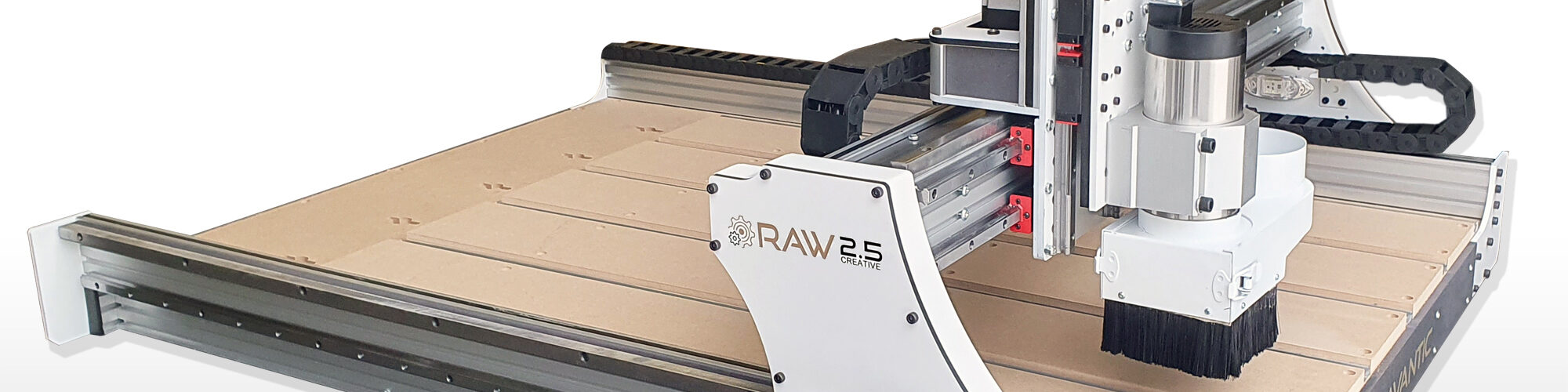
This forum is still new and may look a bit empty at the moment.
Please don’t hesitate to ask your questions. If you are building a Raw Creative 2.5, planning your build or wondering about parts, setup or assembly, feel free to start a topic.
I will do my best to answer questions and help as much as I can. As more builders join, the forum will grow into a useful place for tips, build discussions and shared experience.

Hi everyone,
I'm planning my first Raw Inventive 2.5 build and would appreciate some advice before I start ordering parts.
My intended machine size is relatively small, around 750 mm × 750 mm overall dimensions, and the primary use will be guitar building (acoustic + electric)
fretboard slotting
inlay work and rosettes
truss rod channels, maybe neck carving
body shaping + pickup cavities
templates, moulds and jigs
I do not expect to machine aluminium, at least not regularly. The machine will be used mostly for wood, hardwoods, plywood and occasional plastics.
I already own a complete NEMA23/TB6600/Mach3 electronics kit, so I plan to use that.
I have a few questions:
1. Ballscrews vs Timing Belts
For a machine of this size and intended use, would you still recommend ballscrews over timing belts?
I'm interested in good repeatability and accuracy for fret slotting and inlay work, but I'm not running a production shop and cutting forces will be relatively low.
For those who have used both systems, is there a noticeable real-world advantage to ballscrews for guitar work?
2. Makita Router vs VFD Spindle
I'm debating between a Makita trim router and a VFD spindle.
For fine work such as:
fretboard slotting
small inlays
detailed engraving
is the Makita's runout a practical limitation?
Would I actually notice a difference in accuracy or finish quality, or is the main benefit of a spindle reduced noise and smoother operation?
If you were building this machine today specifically for lutherie work, what would you choose?
3. Steel Plates vs Valchromat
The plans recommend steel plates, which I can order, but I already have a substantial amount of 19 mm Valchromat available.
Given the relatively small machine size (750 × 750), would 19 mm Valchromat be a reasonable alternative for:
gantry side plates
Z-axis plates
carriage plates
motor mounts
provided that it is properly sealed and reinforced where necessary?
Has anyone built a smaller Raw Inventive machine using Valchromat or another engineered wood product for structural plates?
If so, were there any issues with rigidity, long-term stability, or mounting rails and bearing blocks?
I'd love to hear opinions as well as feedback from anyone who has built a similar-sized machine.
Thanks in advance!
Saïan

That is a big question, but I will try to answer the parts I can.
One important thing I think you may have missed is the rack and pinion version. The Raw Creative is not only planned as belt drive and ball screw. The three main drive options are:
Belt drive
Rack and pinion
Ball screw
They all have their own advantages and disadvantages.
Belt drive is the simplest and most budget-friendly version. It is also the version that makes most sense for the Inventables-style budget machine concept, because it keeps the cost down and the parts are easy to source. A belt machine can work very well for wood, plastic, signs, light carving and general DIY CNC work. The downside is that belts are not as stiff as rack or ball screws, especially on larger machines or if you want to push harder in aluminium.
Rack and pinion is, in my opinion, the best option for larger machines. It is strong, scalable and works well over long travel distances. This is the version that makes it possible to build longer machines, even full sheet format, as long as the machine has a strong and flat table underneath it. The downside is that rack and pinion needs more careful setup, alignment and mechanical adjustment compared to belts.
Ball screw is a very good option for smaller, precision-focused machines. It gives smooth movement, good repeatability and very good accuracy when installed correctly. The downside is that ball screws become more expensive and less practical when the machine gets longer. For a smaller machine, for example for guitar parts, aluminium parts, detailed work or high precision projects, ball screws can make a lot of sense.
So I would not say that one drive system is always the best. It depends on what kind of machine you want to build.
For a low-cost DIY machine: belt drive makes sense.
For a larger machine: rack and pinion makes sense.
For a smaller precision machine: ball screw makes sense.
The idea with the Raw Creative platform is to give builders different options, because not everyone has the same budget, tools, workspace or cutting needs.
The belt version is the first fully documented version and can be built now. The rack and ball screw versions are coming later, with illustrations first and full videos after that. These machines take time to document properly because small details in alignment, assembly order and calibration matter a lot.