
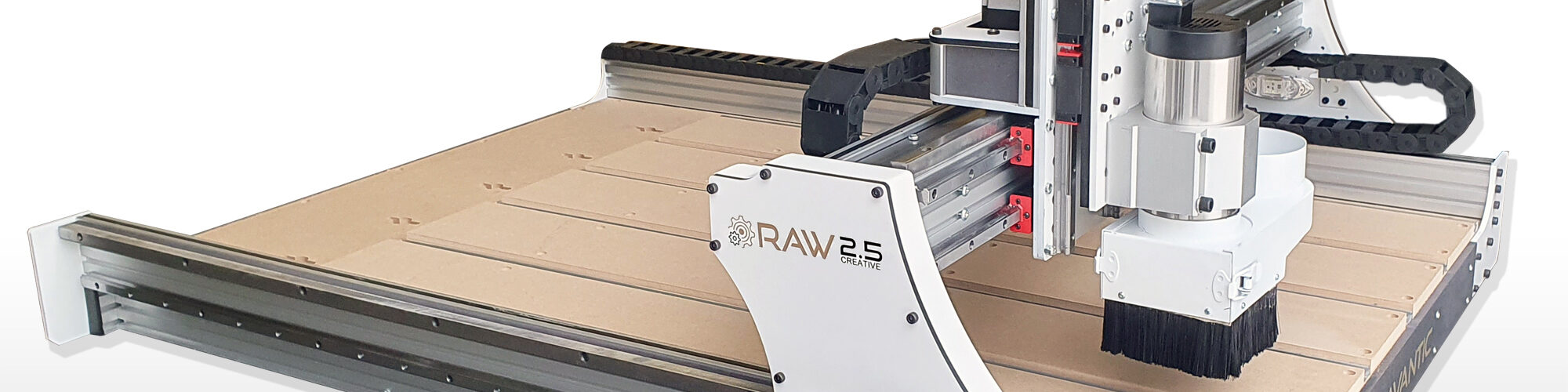
This forum is still new and may look a bit empty at the moment.
Please don’t hesitate to ask your questions. If you are building a Raw Creative 2.5, planning your build or wondering about parts, setup or assembly, feel free to start a topic.
I will do my best to answer questions and help as much as I can. As more builders join, the forum will grow into a useful place for tips, build discussions and shared experience.

Does anyone know of a supplier(s) in the USA that sells aluminum extrusions in long lengths?

I've found a couple, have not compared costs yet and shipping will likely have a big impact. I have also not used either of these suppliers before.
The one I'm having a hard time with is finding a fabricator for the 6mm and 3mm plate parts. Was planning on posting a topic at some point on if .25inch(6.35mm) and .125inch(3.175mm) could be used or how much it would muck things up.

I've found a couple, have not compared costs yet and shipping will likely have a big impact. I have also not used either of these suppliers before.
The one I'm having a hard time with is finding a fabricator for the 6mm and 3mm plate parts. Was planning on posting a topic at some point on if .25inch(6.35mm) and .125inch(3.175mm) could be used or how much it would muck things up.
I don’t think that will cause any major problems.
Using 0.25" plate instead of 6 mm, and 0.125" instead of 3 mm, should be very close. The difference is quite small.
Most of the plates build outward from the machine, so the slightly thicker material should not affect the main geometry very much. The only area I would look a little closer at is the rear plate for the Z-axis, but even there the difference is small and I do not think it will cause a real problem.
So in practice, I think 6.35 mm and 3.175 mm plate should work fine if those sizes are easier to source locally.
If you make a forum topic about it, it could also help other builders in the US, since inch-size plate material is probably much easier to find there.
About supplier(s) in the USA
Those suppliers may be worth checking, especially if shipping inside the US is more reasonable. I have not compared the prices myself, so shipping will probably be a big part of the final cost.
For the longer profiles, especially the Y-axis profiles, I think it should also be possible to join/splice them if you cannot get the full length in one piece.
The linear rails help tie everything together, and you can also use joining plates or connector plates that slide into the slots of the aluminium profiles. If the joint is done carefully and the profiles are well supported underneath, I do not see a big problem with that.
The important thing is that the machine is standing on a strong and flat table/base. The long profiles should not be carrying everything like a freestanding frame. If the whole underside is supported properly, a joined Y-axis profile should work fine in my opinion.
I've found a couple, have not compared costs yet and shipping will likely have a big impact. I have also not used either of these suppliers before.
The one I'm having a hard time with is finding a fabricator for the 6mm and 3mm plate parts. Was planning on posting a topic at some point on if .25inch(6.35mm) and .125inch(3.175mm) could be used or how much it would muck things up.
I don’t think that will cause any major problems.
Using 0.25" plate instead of 6 mm, and 0.125" instead of 3 mm, should be very close. The difference is quite small.
Most of the plates build outward from the machine, so the slightly thicker material should not affect the main geometry very much. The only area I would look a little closer at is the rear plate for the Z-axis, but even there the difference is small and I do not think it will cause a real problem.
So in practice, I think 6.35 mm and 3.175 mm plate should work fine if those sizes are easier to source locally.
If you make a forum topic about it, it could also help other builders in the US, since inch-size plate material is probably much easier to find there.
About supplier(s) in the USA
Those suppliers may be worth checking, especially if shipping inside the US is more reasonable. I have not compared the prices myself, so shipping will probably be a big part of the final cost.
For the longer profiles, especially the Y-axis profiles, I think it should also be possible to join/splice them if you cannot get the full length in one piece.
The linear rails help tie everything together, and you can also use joining plates or connector plates that slide into the slots of the aluminium profiles. If the joint is done carefully and the profiles are well supported underneath, I do not see a big problem with that.
The important thing is that the machine is standing on a strong and flat table/base. The long profiles should not be carrying everything like a freestanding frame. If the whole underside is supported properly, a joined Y-axis profile should work fine in my opinion.
Thank you both for sharing. Given that you mentioned joining extrusions to create the desired full length, are there any drawbacks to this as opposed to using full length 2800mm piece?
Also thought about a kind of torsion box frame, using smaller cuts, easier to acquire lengths. Does that sound feasible?
A full 2800 mm extrusion is of course the cleanest solution, but the main drawback is cost, shipping and availability. A joined extrusion may be slightly less ideal in theory, but if the joint is well aligned, reinforced with internal joining plates/slot connectors, and the profile is supported by a strong table underneath, I do not see it as a major problem.
The important part is that the long Y profiles should not be expected to carry the whole machine like a freestanding bridge. The table/base underneath must support the frame properly.
A torsion box style frame also sounds feasible, especially if it allows you to use shorter and easier-to-source material. A well-built torsion box can be very stiff and flat, so it could make a lot of sense as the base for a larger machine.
So my general view is: full-length profiles are ideal, but spliced profiles with a strong, flat base underneath should also work. For a large machine, the table/base is just as important as the aluminium frame itself.
A full 2800 mm extrusion is of course the cleanest solution, but the main drawback is cost, shipping and availability. A joined extrusion may be slightly less ideal in theory, but if the joint is well aligned, reinforced with internal joining plates/slot connectors, and the profile is supported by a strong table underneath, I do not see it as a major problem.
The important part is that the long Y profiles should not be expected to carry the whole machine like a freestanding bridge. The table/base underneath must support the frame properly.
A torsion box style frame also sounds feasible, especially if it allows you to use shorter and easier-to-source material. A well-built torsion box can be very stiff and flat, so it could make a lot of sense as the base for a larger machine.
So my general view is: full-length profiles are ideal, but spliced profiles with a strong, flat base underneath should also work. For a large machine, the table/base is just as important as the aluminium frame itself.
Understood. I plan to construct a very sturdy and hopefully level base with no open air underneath.

I haven't started sourcing the parts yet but I know from personal experience you can find extruded aluminum from multiple sources. I have purchased very long pieces for rocket launch rails (up to 16' in length). Of course I am buying 1010 and 1515 which I think is imperial sizes? The only problem is the shipping prices for items that long. The shipping costs 2 times the cost the extruded aluminum due to LTL (less than load) shipping.
Just reporting back on my findings in the USA regarding 80x20 and 60x20 extrusions. Most don't stock 80x20 and 60x20 variants.
Misumi was the only site that listed metric extrusions in the custom length up to and exceeding the 2800mm needed for the full-sheet capacity CNC build. Shipping from Misumi was roughly $80 USD. Regarding the LTL (less than load) shipping, they listed UPS and FEDEX and shipping partners, via their ground service. Total cost ~$670 USD (for only frames, no connectors included, no tax, no shipping). Add roughly $80 + your local tax.
Just curious, would these plans work well in the imperial sizing? Or perhaps thicker metric extrusions?
So I thought about what it would take to change the plans to be able to use Imperial Aluminum Extrusions. For example, 8020 Imperial dimensions are 3" (76.2mm) by 1" (25.4mm) and metric is 80mm x 20mm. The holes in the plates are spaced for the metric pieces. So I feel there would be lots of redesigning and trial and error to be done. At that point you are not using these plans.
I have found a couple of companies on Amazon like Kwweeoo Store or IXGNIJ that sell metric versions of extruded aluminum. I think they will sell whole units (1000mm and 1,500mm) $60 and free shipping for Prime members. If you go 1 mm longer or shorter of these longer pieces, the price goes up to the $800 range. There is a possibility there are other companies out there as well.
Thanks for pointing out Misumi. I will check them out.
If I were you I would either buy the largest metric version of aluminum extrusions that you find for a reasonable price and if needed splice them together to reach your full length.
FYI I live close to the Canadian border (driving distance to Montreal) and this country is on the metric system. I have started looking at websites and they are only listing imperial dimensions. I am not sure if their websites know that I am in the US and assume that I only want Imperial sizes or if their market is tied to the US and they only use Imperial sizes. I am still digging around and calling friends up there. Next step is to call some of these companies and ask if they know of sources in Canada that are near me.