
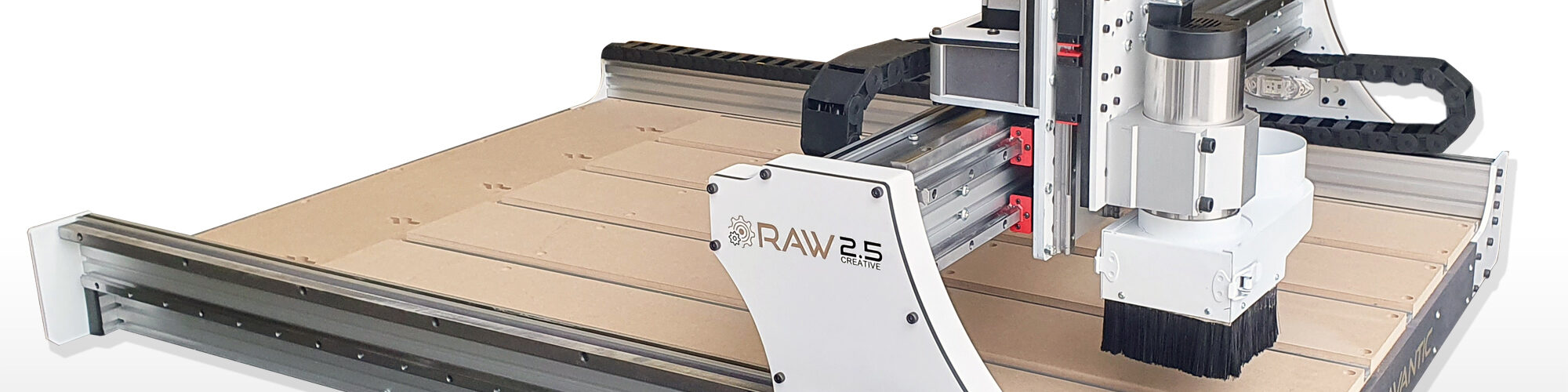
This forum is still new and may look a bit empty at the moment.
Please don’t hesitate to ask your questions. If you are building a Raw Creative 2.5, planning your build or wondering about parts, setup or assembly, feel free to start a topic.
I will do my best to answer questions and help as much as I can. As more builders join, the forum will grow into a useful place for tips, build discussions and shared experience.

Having difficulty finding rectangular steel tubing for X-Axis. Could I substitute a slightly undersized Imperial sized steel tubing (size 3"x1.5"x 1/8")? And then fill the void in the width with something that doesn't compress like washers or metal shims. I don't think the undersized vertical dimension is important to be exact as you are looking for strength.

I think the creator is possibly on vacation but as an engineer I feek I could step in meanwhile to suggest some things to consider.
The steel bar is for bending and twisting rigidity. Since it is not attached at the mounting plates on the side, it adds more rigidity against bending down the x axis than twisting the x bar.
To have the exact same effect with a somewhat thinner steel tube, it's important to realize that to transfer all the forces from the alu profile to the steel tube, the profile must be screwed so tughtly against the steel that the surface friction is higher than any forces trying to move the alu profile.
If the friction is not high enough, the bending force would land on the bolts and then transfer to the steel tube. But the bolts would experience cutting and twisting forces. So if you just put shims or washers on the bolts, you won't get the support you want.
To make this work, you would be better off cutting a steel sheet of a sufficiant gauge and fill the space entirely.
The tube itself is definitely strong enough but make sure the alu profile rests in the entire length of ty steel tube on its surface
This is generally speaking, but unless you are going to push the machine very hard like cutting metal etc you could probably get away with washers. Personally I wouldn't do that though.
I am at the moment building this machine too (buggest size, rack and pinion), but as I live in Sweden, I fortunately got the correct measure steel bar from a supply just half a mile from home. Easier for me than you, but no worries, you will figure this out.
Good luck!

Thank you Steve and you are correct, the steel tube is more for bending than twisting, but for regular use shims will work, you can also use a 60x80 aluminiumextrusion bar, but steel is better. And yes im on vacation and my replies will be a bit late,

Hey there, I’m working on sourcing parts in the US for my own build and because I’m aiming for 4x8 capability I have to find a steel tube that is 1500mm (1460 after taking 20 off each end)
I found a company in VA that will sell metric metal non wholesale but I fear shipping will be astronomical going from the east coast to west.
Couple of questions. How tight is the tolerance between extrusions? In imperial sizing I can get a 3”x1.5” tube as mentioned above, and 14 gauge steel at 0.075” as a shim would put the overall thickness at 76.2 x 39.997mm
The next idea is to use 2 pieces of 80x40 like it was mentioned, since it’s cheaper to ship that way. Any noticeable difference in rigidity? And would it be worth having them welded back together as long as the welder is good and keeps everything perfectly straight?
Here in Sweden, shipping of things shorter than 2m (approx 80 inches) is not extremely expensive.
The tolerance is pretty tight which is needed for transfer of the forces. If you go gorward with imperial tubes and shims, do not weld them but simply just clamp them with the screws.
I replaces the suggested steel screws with machine screws which made it necessary no bore and tap the holes. But doing so allow for higherclamping force, which I would recommend in case you use shims. Well I recommend it regardless.
Also I can mention that I did cut the steel tube the exact same length as the aluminum extrusions. To allow for cable routing, I cut an opening at the bottom side of the tube at both ends where meets the side steel plates.
Another solution would be to adjust the dxf files of the side plates to allow for imperial tube.
The downside to any welding of the tube is that it could warp and give you alignment- and adjustment issues.
Good luck with your project. This is an excellent machine. Well worth money and time put into it.
Unfortunately the metric sizing is quite difficult to source in the USA, so far I've found 1 company willing to sell it to me (I'm not a business owner, and the other company only does B2B sales)
I'm waiting to hear about shipping a 3 meter piece, potentially 2x 1.5m pieces. But one of our large shipping carriers here scales very quickly when the piece is over 50". So this company opts to put it on a truck as a freight charge.
Hopefully not too crazy, as I'd prefer to build the machine as designed without shimming an imperial piece
Yeah, I get that. You could potentially opt to use flat iron bars of sufficient amount as well as a backup plan if shipping becomes prohibitively expensive. It would be even stronger than the tube, but also heavier. The bearing blocks can handle pretty extreme loads though so I think that would work just fine.
My guess is that it's provably cheaper to have the tube cut to length than send it whole. Even if they charge you to make that extra cut.
Depending on what you plan to use your machine for, and the size of the spindle, you could opt for aluminum instead too if the extra rigidity isn't needed. There is an additional possibility: wood.
Wood is ridiculously strong and if you buy a hardwood piece of furniture grade (it must be very dry so it doesn't shrink and from a cut that won't warp) and have it sized to fit, that would be really strong too. Perhaps even stronger than the steele since it's massive instead of a tube. Or you could combine a wooden core with two flat steel plates of sufficient gauge.
You have many options, it depends on what you wish to use the machine for. If you need any engineering input as to rigidity etc, just post it here and we'll help you figure it out.
You won't regret building this machibe, let me tell you. It's a dream machine.
So you wouldn't be too worried about gantry weight? The same supplier that has 2mm wall has 3mm available now. The 2mm would be 6-10 weeks lead time because they're out of stock.
I was worried about adding additional weight to the gantry, as I was planning on trying to source a 2.2kw ISO20 spindle if I can manage... as ATC would certainly be a luxury. And was thinking I might want to keep the moving mass lower?
Thanks in advance, looking forward to the build
For the US folks looking for tube Spahr Metric is the supplier I tracked down
Yes, I think your solution should work fine!
The important dimension is the 40 mm thickness, as the steel tube sits between the aluminium extrusions. Your 3" × 1.5" tube with a 0.075" shim gives almost exactly 40 mm, which is what we need.
The other dimension, 76.2 mm instead of 80 mm, should not cause any problems.
Using two 80 × 40 aluminium profiles is also an option, but personally I would prefer the steel tube for better rigidity, especially on a machine this large.
I would avoid welding the aluminium extrusions together, as the heat could cause distortion. Mechanical joining would be my preferred solution.
So if you can source that steel tube locally, I think you have found a good alternative.