
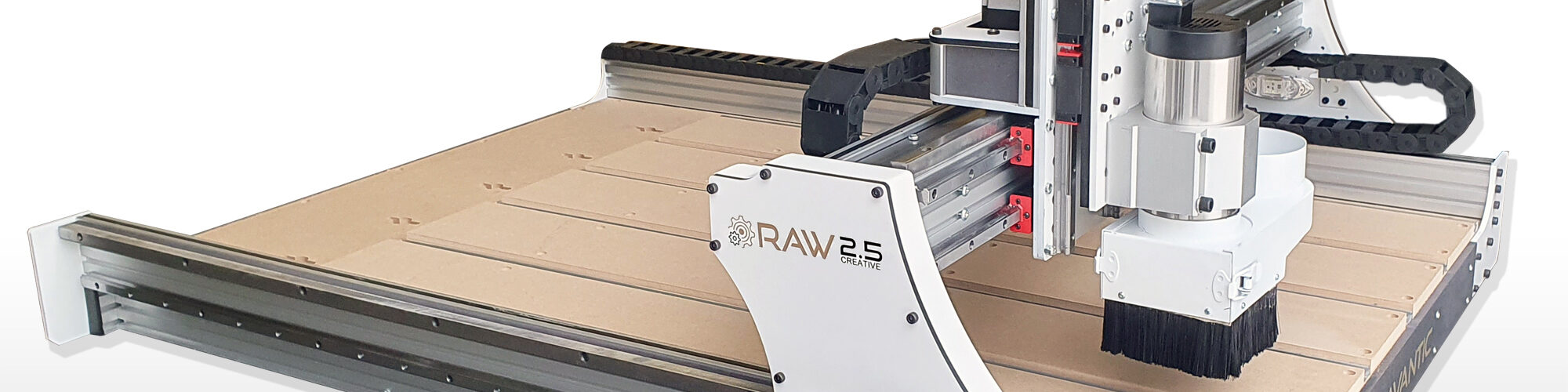
This forum is still new and may look a bit empty at the moment.
Please don’t hesitate to ask your questions. If you are building a Raw Creative 2.5, planning your build or wondering about parts, setup or assembly, feel free to start a topic.
I will do my best to answer questions and help as much as I can. As more builders join, the forum will grow into a useful place for tips, build discussions and shared experience.

Helical rack, isent it better for talest version.

Yes, helical rack is a very good option, especially for larger machines. It gives smoother motion and better contact than straight rack.
The only downside is availability. Helical rack can be harder to find, especially MOD1 helical rack. We buy ours directly from the factory, so for us it is not a problem, but for a DIY builder it can sometimes be more difficult to source locally.
So yes, helical rack is a strong choice, but availability and price are the main things to check first.
Rack material not c45 #45 but better

There's a lot to consider here. Helical rack- and pinions do allow for smoother motion and a significantly reduced backlash. Both adds to precision if everything is adjusted properly. This is ofcourse great.
My questions regarding this choice is: are those advantages in your opinion enough to make the higher cost worth it in this particular cnc?
And also: due to the angled design, only one part of the force generated by the motor is translated into linear motion along the rack. The other vector becomes a pushing/pulling vector along the stepper axis.
This means it's important to make sure the steppers are up for that. This is a mechanical engineering issue. The bearings in a motor are generally not good at handling force applied axially.
The engineering part here is that if you operate this machine at the speed it's proven capable of, the rapid stopping and reversing especially for y axis can introduce a substantial load on the motor.
I wonder if the motors included in the electronics kit have the capacity needed for handling of axial loads. And maybe if you have a datasheet to share for those steppers so I can check the numbers. The weight of the x-axis besm with z axis, how many kilos is that (with no spindle). Given a datasheet and that info I'm able to calculate the forces and torques and figure out what would be a maximum speed of movement to keep loads within specs of the motor.
If a gearbox is used, this will be removing load from the stepper axis and putting it into the gearbox instead. This could be bad or good depending on specs for the motor vs gearbox and also the price of the motor vs the gearbox. Which part is cheaper to replace when it fails?
I will offer my findings regarding this for the good of this community.
Finally, one more question: it seems helical mod 1.5 is easier to source. Those allow for more power to be transferred but since they are larger I guess this would mean less precision in the machine?
That is a very good observation, and you are correct.
A helical rack does create an axial force component because of the angled tooth geometry. So in theory, the motor shaft and motor bearings can see a load that they would not see in the same way with a straight rack.
On our larger machines, when we use helical rack, we normally use a gearbox/reduction system. That is the better engineering solution, because the axial and mechanical loads are handled in a more controlled way and the motor is not exposed in the same direct manner.
That said, we have also tested helical rack with direct drive, and in practice it works better than many people would expect. It is not the most ideal engineering solution on paper, but our tests have shown that it does not seem to affect the stepper motor much in this type of machine. What becomes more important is that the motor plates are correctly adjusted and calibrated, so the pinion engagement is correct and the motor is not forced into a bad mechanical position.
We have machines running daily with helical rack and direct drive, and they cut just as well as our machines with reduction. So from a practical point of view, the solution works.
But I agree with your point: on heavier machines, or machines with higher moving mass and higher acceleration, direct drive with helical rack is not the right solution. At that point a gearbox or reduction system is the better way to do it.
Regarding cost, I think helical rack is worth it if the parts are available at a reasonable price. The motion is smoother, backlash can be reduced, and the machine feels more refined. The downside is sourcing. MOD1 helical rack can be difficult to find for DIY builders, and that is one reason we do not want to make the project too dependent on parts that are hard to source.
Regarding MOD1.5: yes, it is often easier to source and it can transfer more force because the teeth are larger. The tradeoff is that the pitch is larger, so with the same pinion and motor setup the resolution becomes lower compared to MOD1. It does not automatically mean the machine becomes inaccurate, because microstepping, pinion size, reduction and machine stiffness all matter, but MOD1 is generally the better fit for this type of CNC if the goal is a good balance between precision, size and availability.
So in short:
Helical rack is better for smoothness and backlash.
Straight rack is simpler and easier for DIY sourcing.
MOD1 is usually a better fit for this size of CNC.
MOD1.5 is stronger and easier to find in some markets, but gives lower resolution with the same drive setup.
Direct drive helical rack can work on this machine, and we have tested it successfully.
For heavier or more professional machines, helical rack should ideally be used with gearbox/reduction.
I really appreciate that you are looking at this from an engineering point of view.